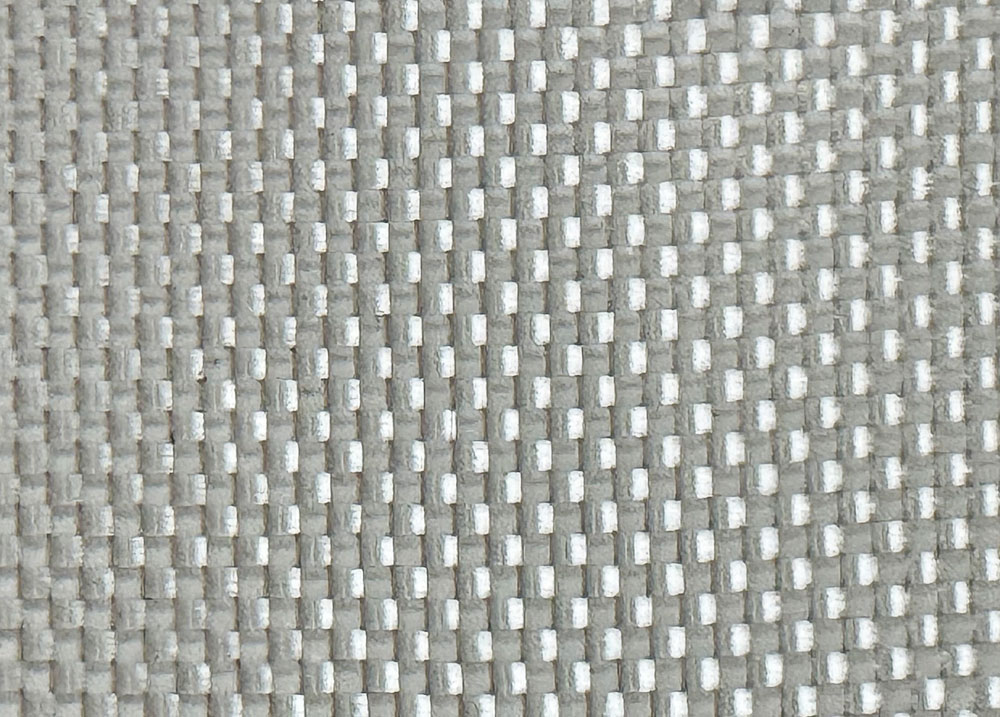
Industrial polyester woven fabric offers strength, corrosion resistance and dimensional stability, which is why it remains one of the most widely specified synthetic woven materials across industrial, technical and protective applications. We weave polyester filament and staple yarns into fabric constructions engineered for durability under repeated mechanical stress, moisture exposure and dimensional change — performance characteristics that go well beyond what the apparel-grade version of the material is built for.
Polyester fiber's inherent low moisture absorption, good tensile strength and resistance to chemical and biological degradation make it a dependable base material wherever a fabric needs to hold its shape, strength and finish over a long service life. Compared with natural fiber alternatives, industrial polyester woven fabric resists rot, mildew and most common industrial chemicals, while maintaining tighter dimensional tolerances under heat and humidity — properties that matter directly to engineers specifying material for load-bearing or outdoor-exposed applications.
| Fields | Scenarios | Performance |
|---|---|---|
| Apparel & Textile | Sportswear, Outdoor jackets, Shirts | Lightweight, Quick-drying, UV resistant |
| Home Decoration | Curtains, Sofas, Bedding | Wrinkle-resistant, UV-resistant, Flame-resistant |
| Industrial Materials | Conveyor belts, Filter fabrics, Geogrids | High strength, Corrosion resistance, Dimensional stability |
| Medical Protection | Surgical gowns, Protective masks (outer layer) | Liquid barrier properties, Anti-static properties |
| Parameters | Polyester Woven Fabric | Cotton Woven Fabric | Nylon Woven Fabric |
|---|---|---|---|
| Density (g/cm³) | 1.38 | 1.54 | 1.14 |
| Tensile strength (MPa) | 50–80 (filament) | 20–40 | 60–100 |
| Moisture absorption (%) | 0.4 | 8–10 | 4.5 |
| Abrasion resistance (Martindale cycles) | 10,000–30,000 | 2,000–5,000 | 15,000–50,000 |
| Thermal shrinkage at 150°C (%) | <3% | High shrinkage tendency | 5–8% |
Polyester woven fabric for conveyor belts provides strength and dimensional stability, which is exactly what the carcass layer of a conveyor belt needs to perform reliably under continuous tension, repeated flexing and varying load. Low moisture absorption keeps the fabric's strength and dimensions consistent even in damp or washdown environments, while the fiber's high tensile strength and low elongation under load help the belt resist stretching out of specification over its service life — a common failure mode with lower-grade reinforcement fabrics.
Beyond conveyor belting, the same property set extends naturally to other industrial reinforcement uses, including filter fabrics where dimensional stability under repeated wash cycles matters, and geogrids where long-term tensile performance under sustained load is the primary design requirement.
Q.How does industrial polyester woven fabric compare to cotton or nylon woven fabric?
Polyester offers a balanced profile of moderate density, good tensile strength and very low moisture absorption compared with cotton, while nylon generally offers higher tensile strength and abrasion resistance but greater moisture absorption and thermal shrinkage than polyester.
Q.Is polyester woven fabric suitable for conveyor belt carcass reinforcement?
Yes. Polyester woven fabric for conveyor belts is widely used as a carcass reinforcement layer because of its high tensile strength, low elongation under load and low moisture absorption, which together support dimensional stability over the belt's service life.
Q.Can GSM, weave pattern and width be customized for industrial applications?
Yes. GSM, weave pattern and width can be adjusted to match the tensile, abrasion or filtration requirement of your specific industrial application, whether for conveyor belting, filter fabric or geogrid reinforcement.
Q.How does polyester woven fabric perform under heat compared to nylon?
Polyester generally shows lower thermal shrinkage than nylon at elevated temperatures (under 3% versus 5–8% for nylon at 150°C), which supports better dimensional stability in applications exposed to repeated heat cycling.